California field sanitation rules for hand-labor agriculture generally require toilet and hand-washing facilities for crews, commonly at a ratio of one toilet and one wash station per 20 workers, located close enough…
California field sanitation rules for hand-labor agriculture generally require toilet and hand-washing facilities for crews, commonly at a ratio of one toilet and one wash station per 20 workers, located close enough that workers can reach them within about a five-minute walk. That ratio drives the count, and the walking-distance rule drives placement — which is why harvest orders are quoted after a sizing conversation about crew size and block layout, not from a flat price list. Give the crew count and the block you are starting in, and the recommendation comes back as a unit count and a placement plan before any number is quoted.
Riverside's remaining ag ground sits in pockets, and each pocket has its own access problem. The citrus groves along Victoria Avenue and the terraces near Hawarden Hills have narrow shoulders and rows that dead-end, so units are usually staged at a driveway or cross-street where a service truck can pull in without backing 200 feet between trees. Field ground on the Northside and in the Santa Ana River bottom near Arlanza and La Sierra is flatter and easier to reach, but soft after irrigation — placement there gets set on the packed edge of the turn row rather than in the field. Groves and small parcels near California Citrus State Historic Park, and the ag edges around Casa Blanca, Orangecrest and Mission Grove, are close enough to town that same-week scheduling is straightforward. Tell dispatch which gate is unlocked and who is on site, and the delivery gets confirmed for that window.
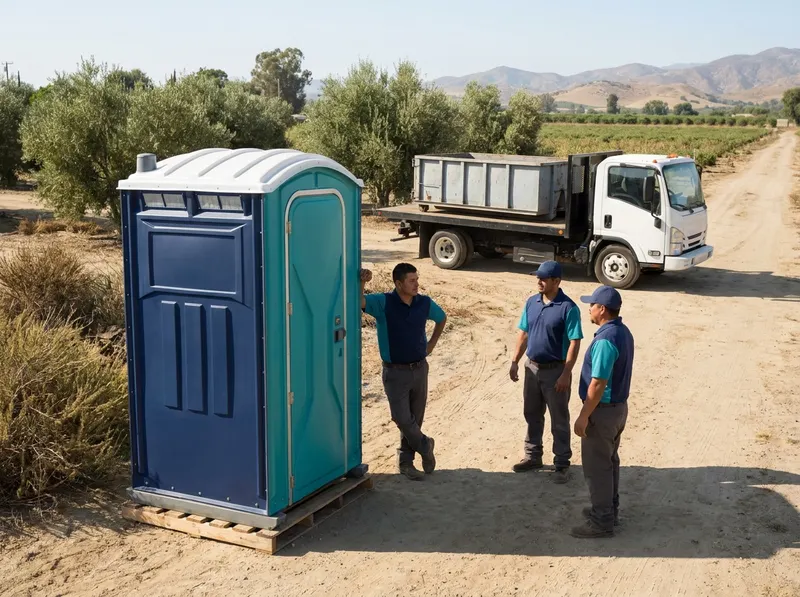
Standard field units are the right call for almost every harvest, pruning, thinning or planting crew: they are light enough to relocate as the crew moves between blocks, they need no water hookup, and one truck can service several of them in a single stop. Restroom trailers are the alternative, and they are the wrong tool in a grove — they need level ground, a water source and shore power, and they do not follow a crew down a dirt turn row. The trade-off with standard units is honest: a relocation charge applies each time units are moved, so plan the season in stages, or place two smaller clusters instead of one and skip the moves. Longer crews also do better with a hand-wash station per toilet rather than one shared station, because a single station becomes the bottleneck at break.
Service frequency is the other decision. Weekly service covers a standard crew of up to about 10 workers per unit. A 20-worker crew on the same unit, or hot Inland Empire weeks in the middle of harvest, generally needs twice-weekly visits — that is added to the schedule up front rather than discovered when a unit is full. Every visit is logged with a date, which matters when a labor contractor, an auditor or a Riverside County inspector asks for a service record. Extra charges are limited to what is stated at booking: additional service visits, relocations, blocked-access return trips, and damage beyond normal use.
Every job gets a firm, written price after a free on-site visit.
Tell us about your agricultural & harvest crew restroom rental job in Riverside and we'll send a clear, written quote — usually the same day.
 RapidNest Temporary Restrooms Services